Can You Swim in La Réunion?
Yes — here’s where, and the one rule to know before you go.
Let’s start with the answer, because it’s the one you came for: yes, you can swim in La Réunion.
People swim in the lagoon every day, all year round, with their kids, for hours. Shallow water, around 26°C, flat and clear. It’s the sea this island has always used.
There is one rule to know before you arrive — one, and it’s simpler than the internet makes it sound. But first, the good part.
The lagoon: where you swim without thinking about it
The lagoons are at L’Hermitage, La Saline-les-Bains, Saint-Leu, Saint-Gilles, Saint-Pierre and Étang-Salé.
L’Hermitage and La Saline are the widest and the best equipped: casuarina trees shading the sand, snack bars a few steps away, parking. If you’re short on time and just want a sea to get into without asking questions, go there.
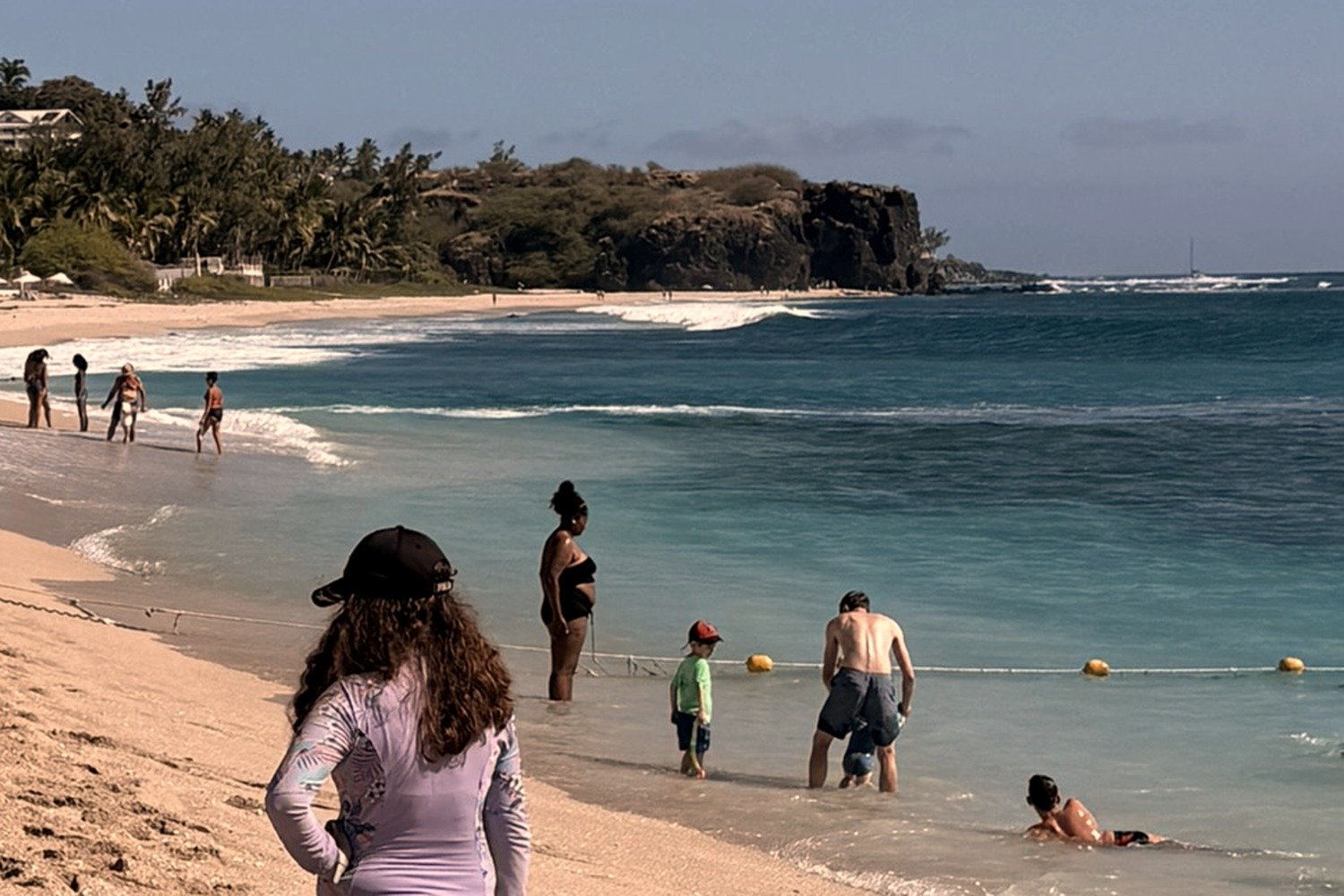
Then there are the open-sea beaches made safe by an anti-shark net and active surveillance: Boucan Canot, Roches Noires at Saint-Gilles, and Étang-Salé. These aren’t lagoons — they’re real beaches, with waves — but the perimeter is visible to the naked eye: a line of yellow buoys, and inside it you’re fine.
Our best afternoon was there. For me, swimming inside a perimeter was still a new idea. For Tom it was just an afternoon at the beach.
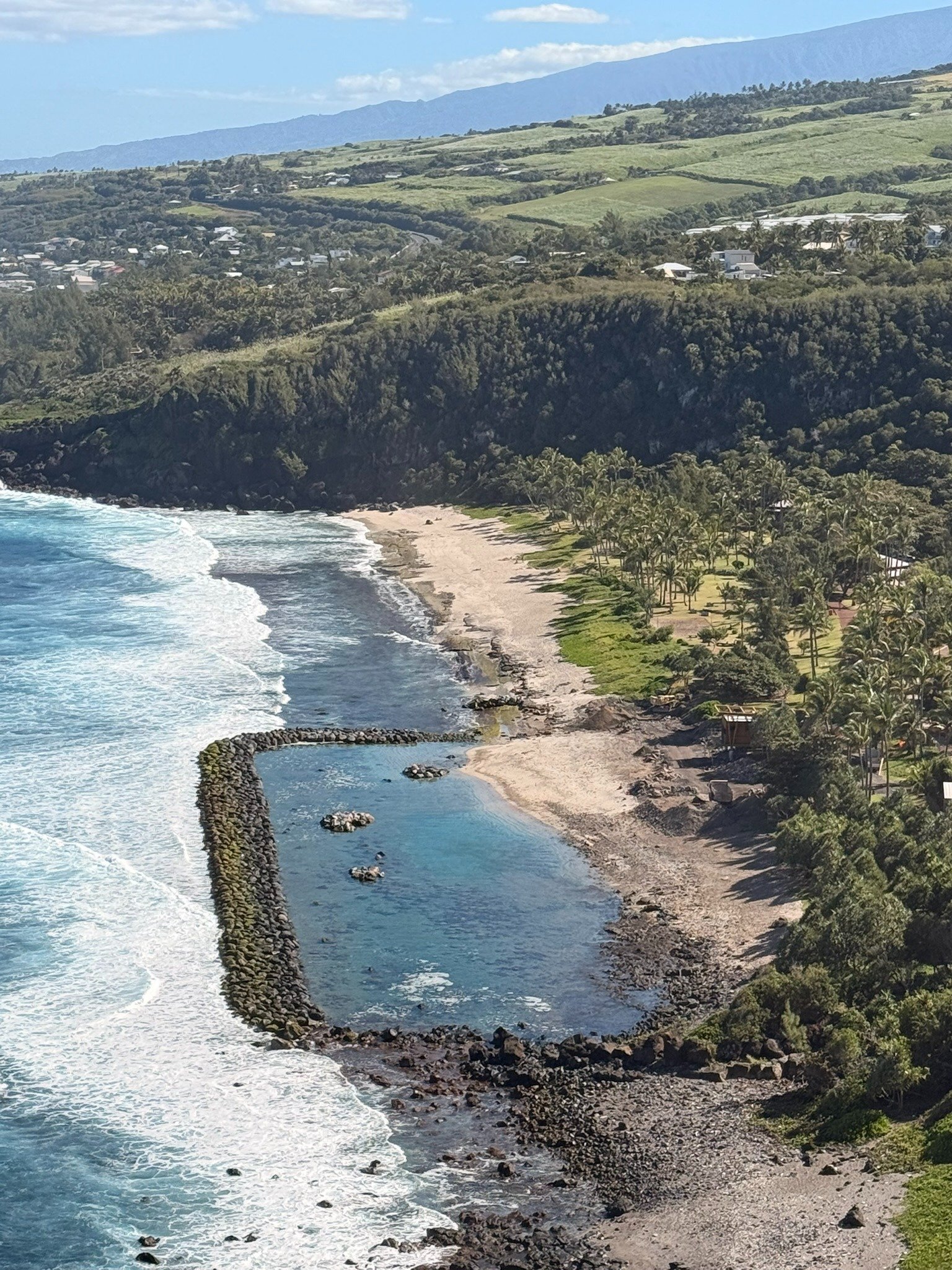
In a few places along the coast there are also sheltered sea pools — natural basins protected from the swell by a barrier of rocks.
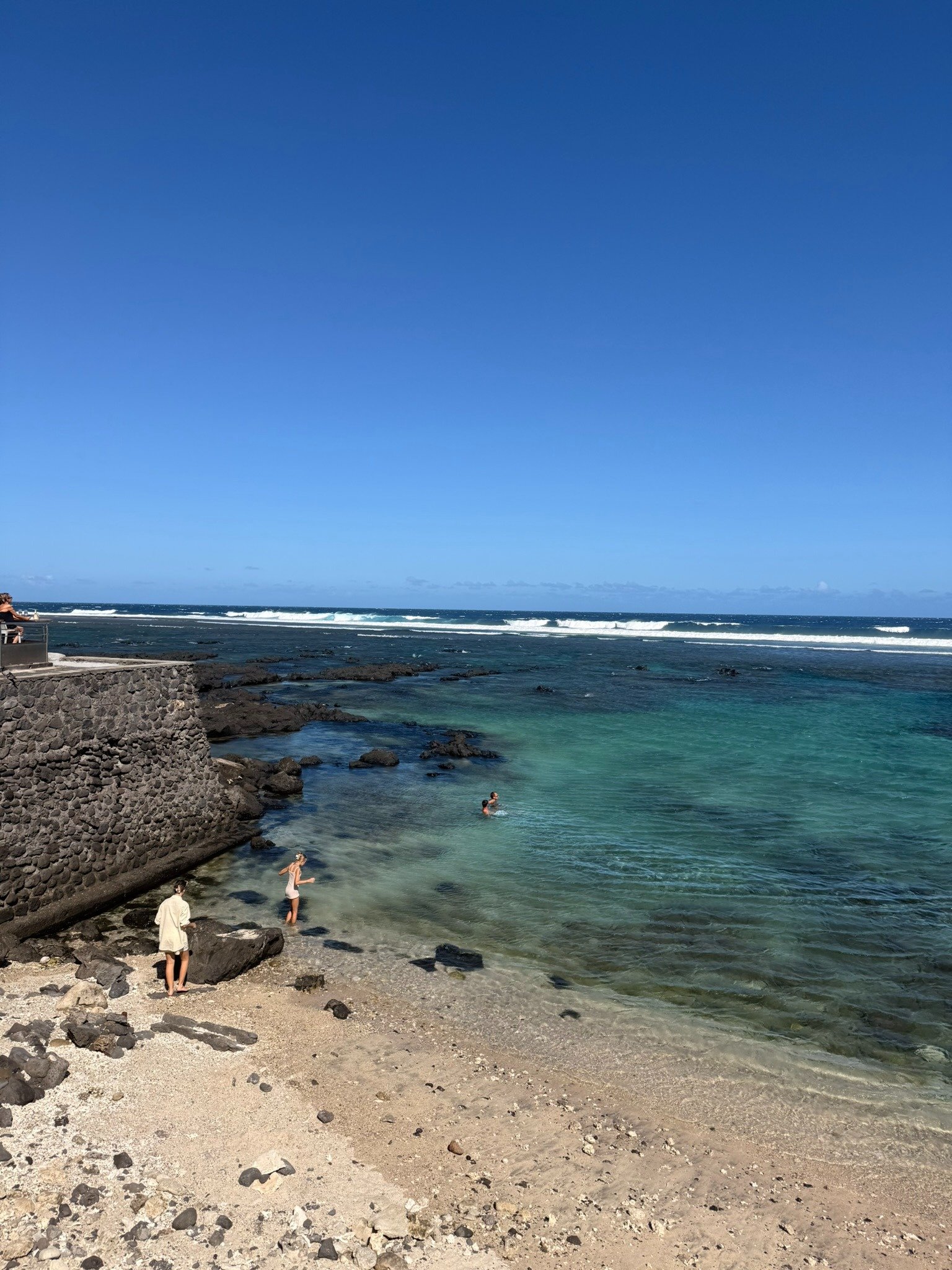
Along the west and south-west coast, a coral reef runs parallel to the shore a few hundred metres out. You can spot it without being told: it’s that white line of breaking waves offshore. Between the reef and the beach lies a strip of enclosed sea — the lagoon.
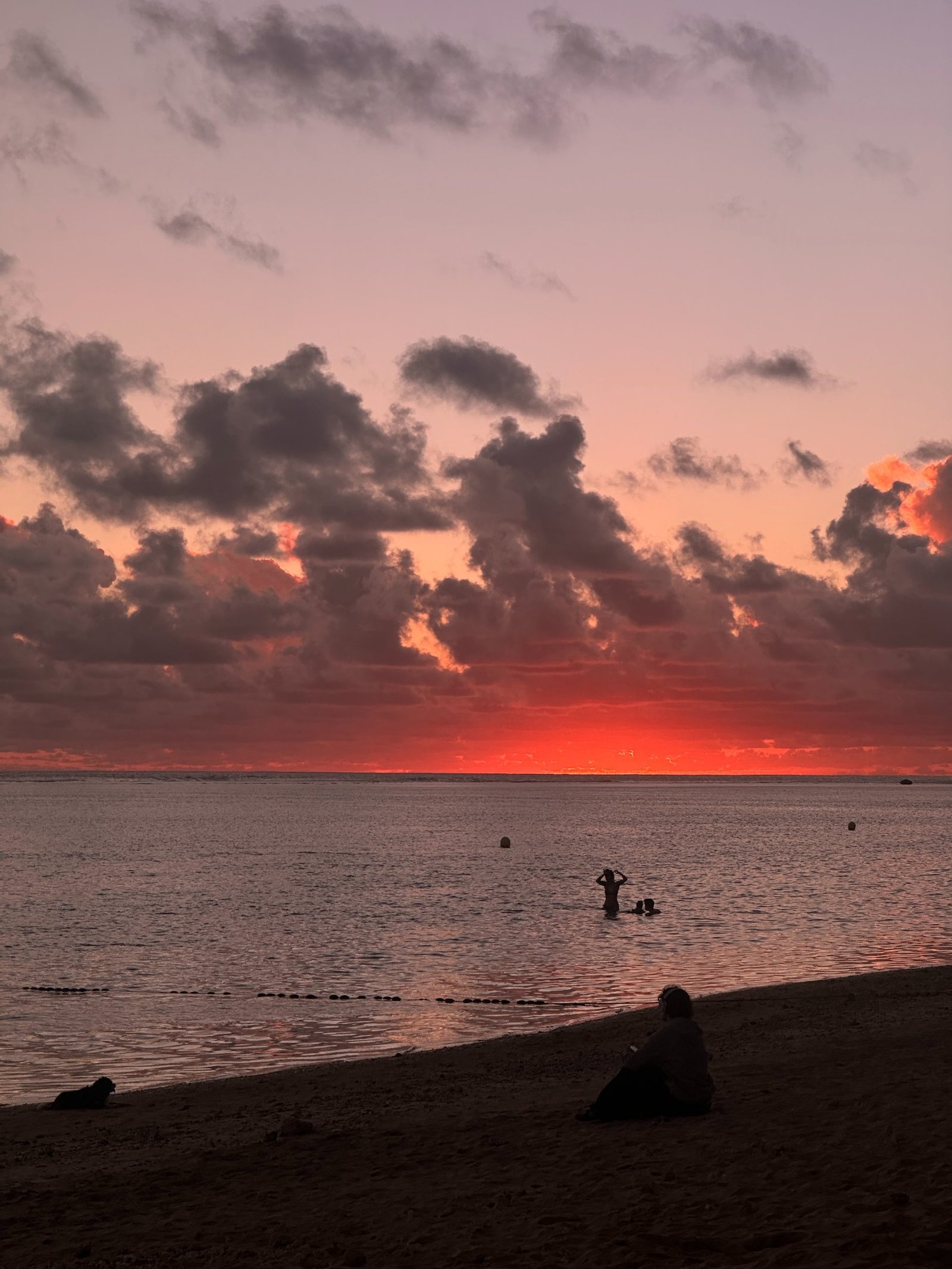
Inside it, the open ocean doesn’t reach you. The water comes up to your waist, sits at around 26 degrees, and has no waves and no current. You see fish without doing anything special: a mask and ten minutes will do. This is where local families spend the whole of Sunday, where children learn to swim, where people get in the water at seven in the morning before work.
The one rule to know
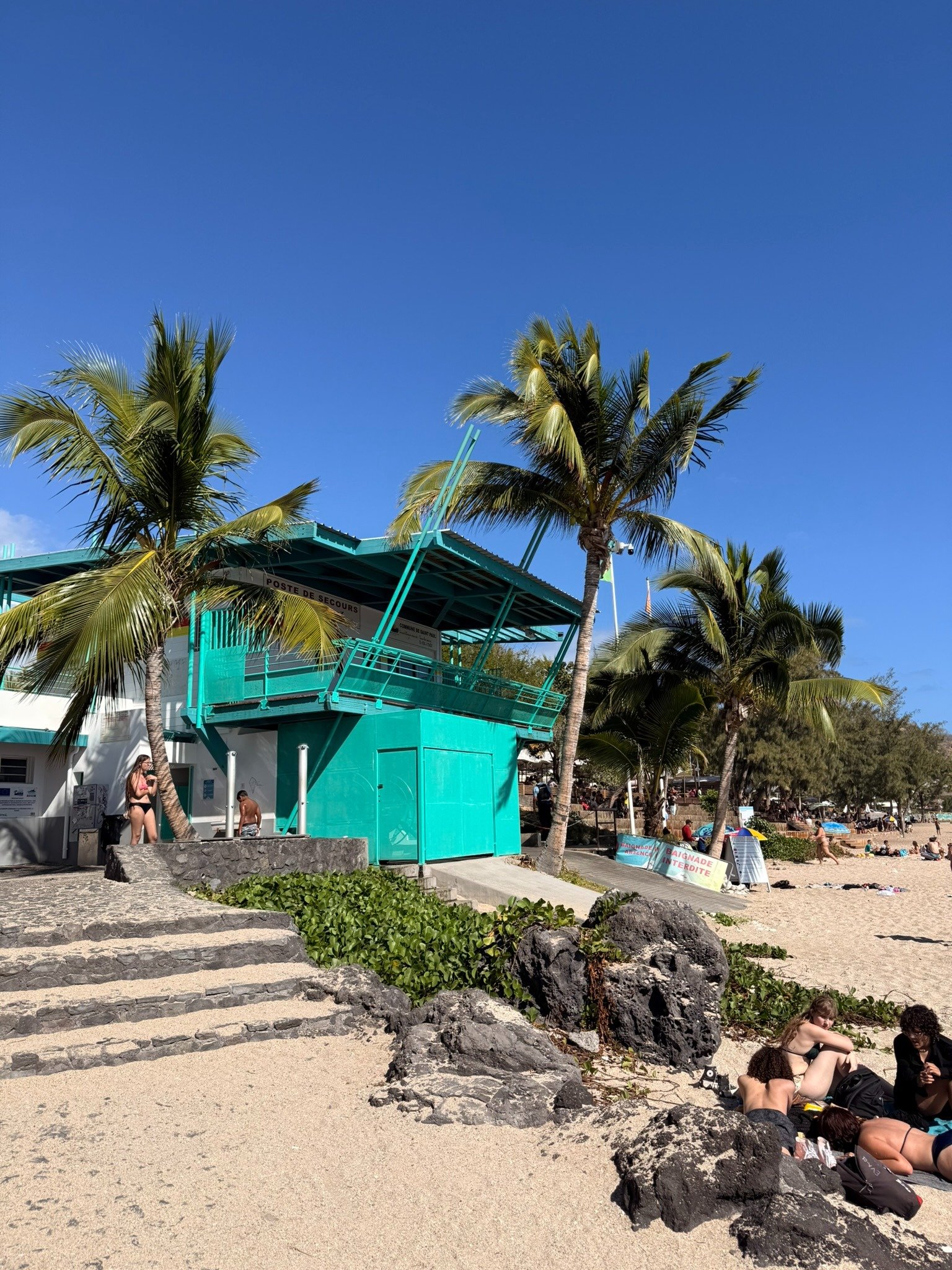
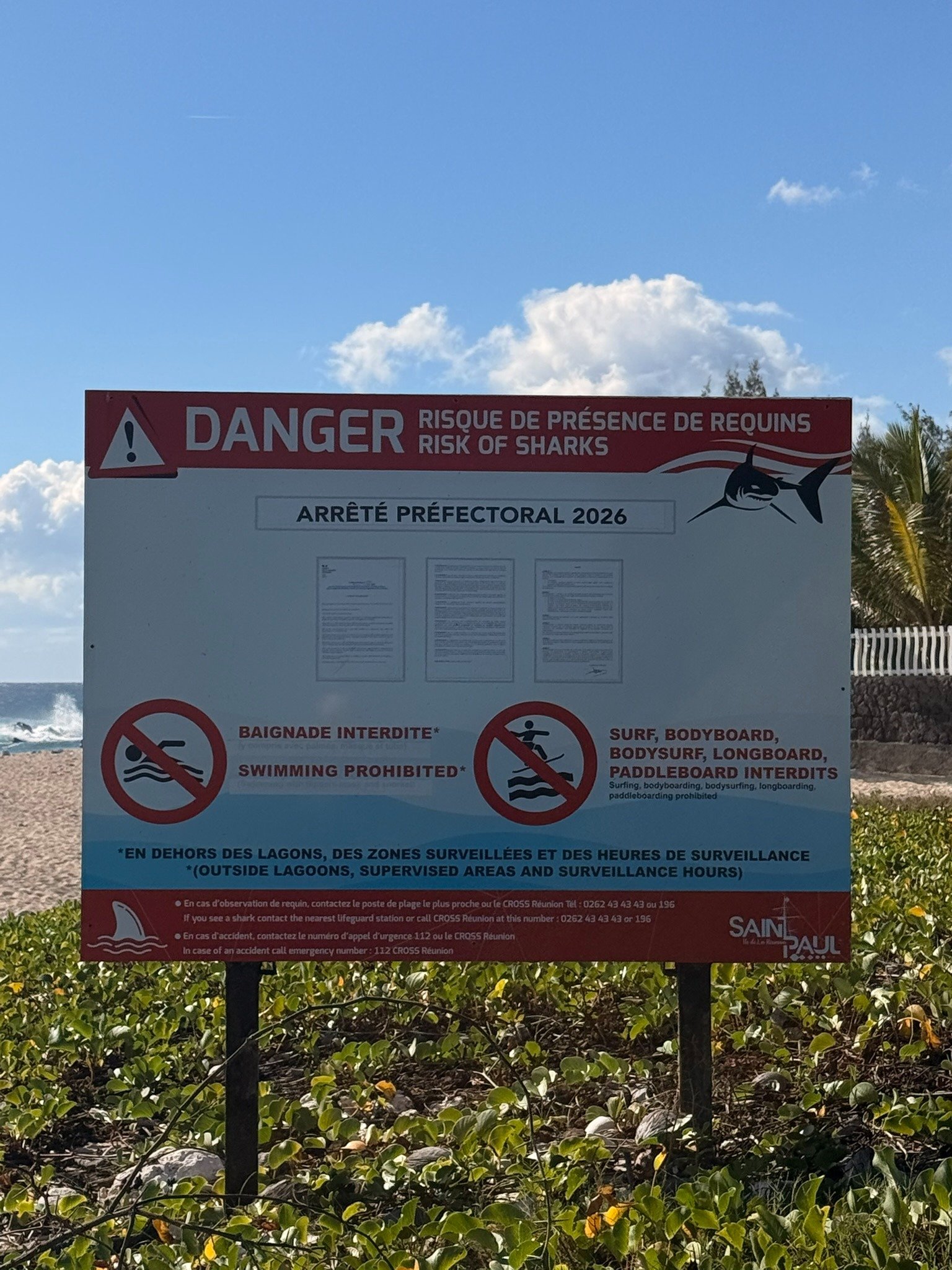
Outside those places — lagoons, supervised zones, purpose-built areas — swimming is prohibited. Not discouraged: prohibited, by prefectural order, within 300 metres of the shore.
The sign puts it better than any guidebook:
BAIGNADE INTERDITE — en dehors des lagons, des zones surveillées et des heures de surveillance (Swimming prohibited — outside lagoons, supervised zones and supervised hours.)
Two things to keep in mind, and then you can stop thinking about it.
The hours matter as much as the place. A supervised zone is only supervised during supervised hours. Same beach, same water — at six in the evening the rule is different. Zones and hours are announced each morning by the Centre Sécurité Requin. You check before heading out, the way you’d check the weather.
The rule comes from something real. Between 2011 and 2019 the island went through what everyone here simply calls la crise requin. Tom lived through all of it as a kid — he grew up on an island whose sea was closing — and he left in 2019, the year of the last attack. There have been none since, and that’s precisely because the nets, the shark spotters and the water patrol work. In November 2025 the net at Boucan Canot stopped a shark without anyone getting hurt: it isn’t decorative.
That said: inside the lagoon nobody thinks about sharks. You think about them about as much as you’d think about rip currents at home. It’s local common sense, not daily anxiety.
If you snorkel: since February 2025, swimming with fins, mask and snorkel has been permitted within the 300-metre band, while swimming without equipment remains prohibited outside authorised zones. Around Cap la Houssaye, for instance, people get in specifically to snorkel and there are dive schools operating. The regulation is renewed annually, so check the current version before you travel — and trust the local press over the official website, which lags behind.
What about fresh water? The Trois Bassins problem
There’s a municipal order dating from 12 September 2003, which the town of Saint-Paul reaffirmed on 6 March 2025 after Cyclone Garance, because of instability in the cliffs above the ravine. Swimming is prohibited for a second, separate reason too: that water is a drinking-water catchment. In its own statement the town writes that “de nombreuses personnes continuent de s’y rendre” — many people keep going there anyway.
I found this out afterwards. Tom didn’t have to: he knew, the way anyone who grew up here knows. It’s been the normal condition of the place for twenty years — a ban that exists, that everyone is aware of, that nobody enforces, on a path the whole island walks on a Sunday.
We’re not telling you to go and we’re not going to lecture you. We’re telling you the facts: it’s prohibited, the entire island goes anyway, and the cliff is under geological survey. The ban could be lifted around 2030, once the water catchment moves to underground boreholes.
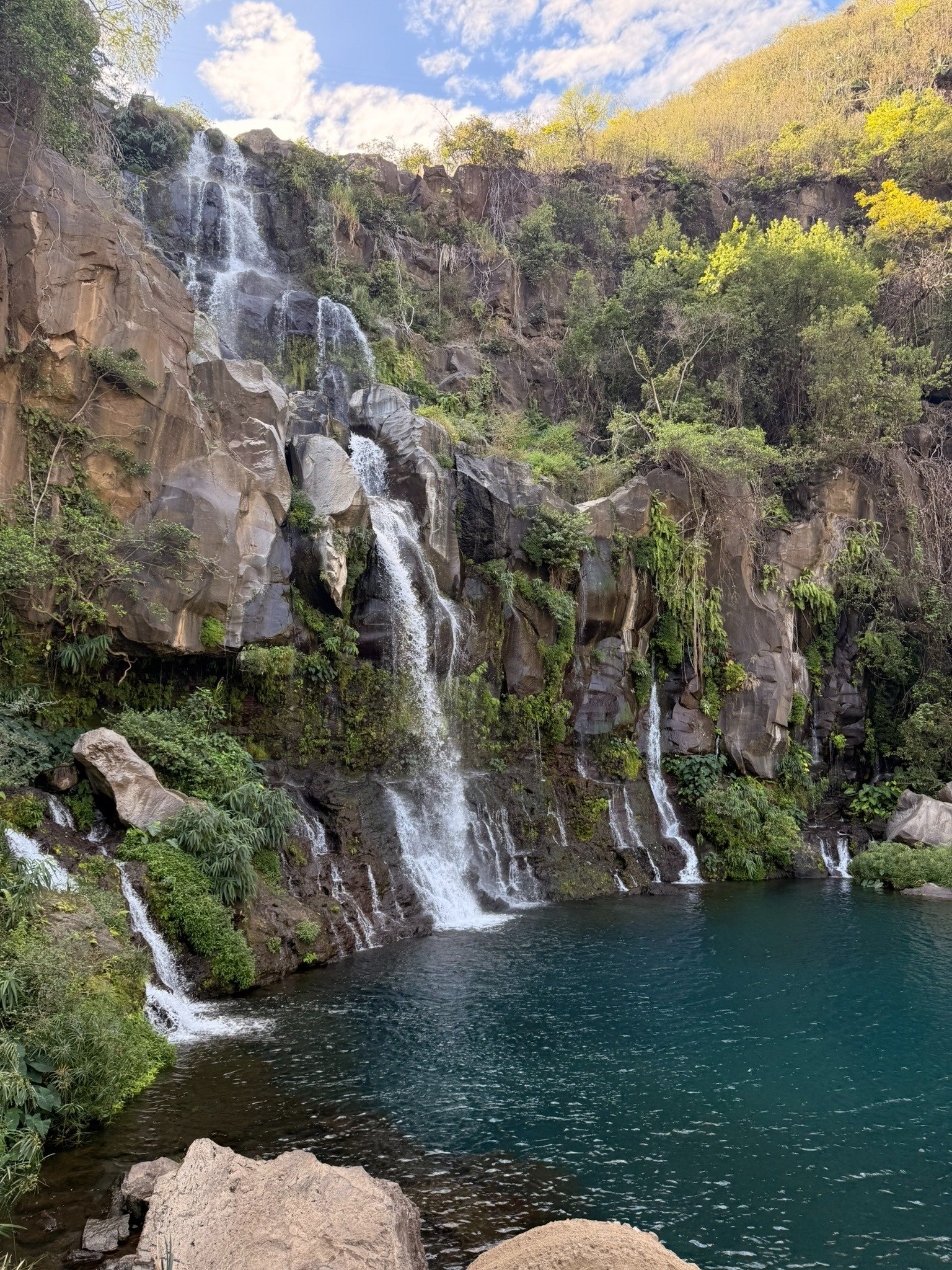
The reflex, at this point, is immediate: fine, I’ll go to a waterfall instead.
We did too. One morning in August we walked the Trois Bassins circuit above Saint-Gilles, up to the two highest falls.
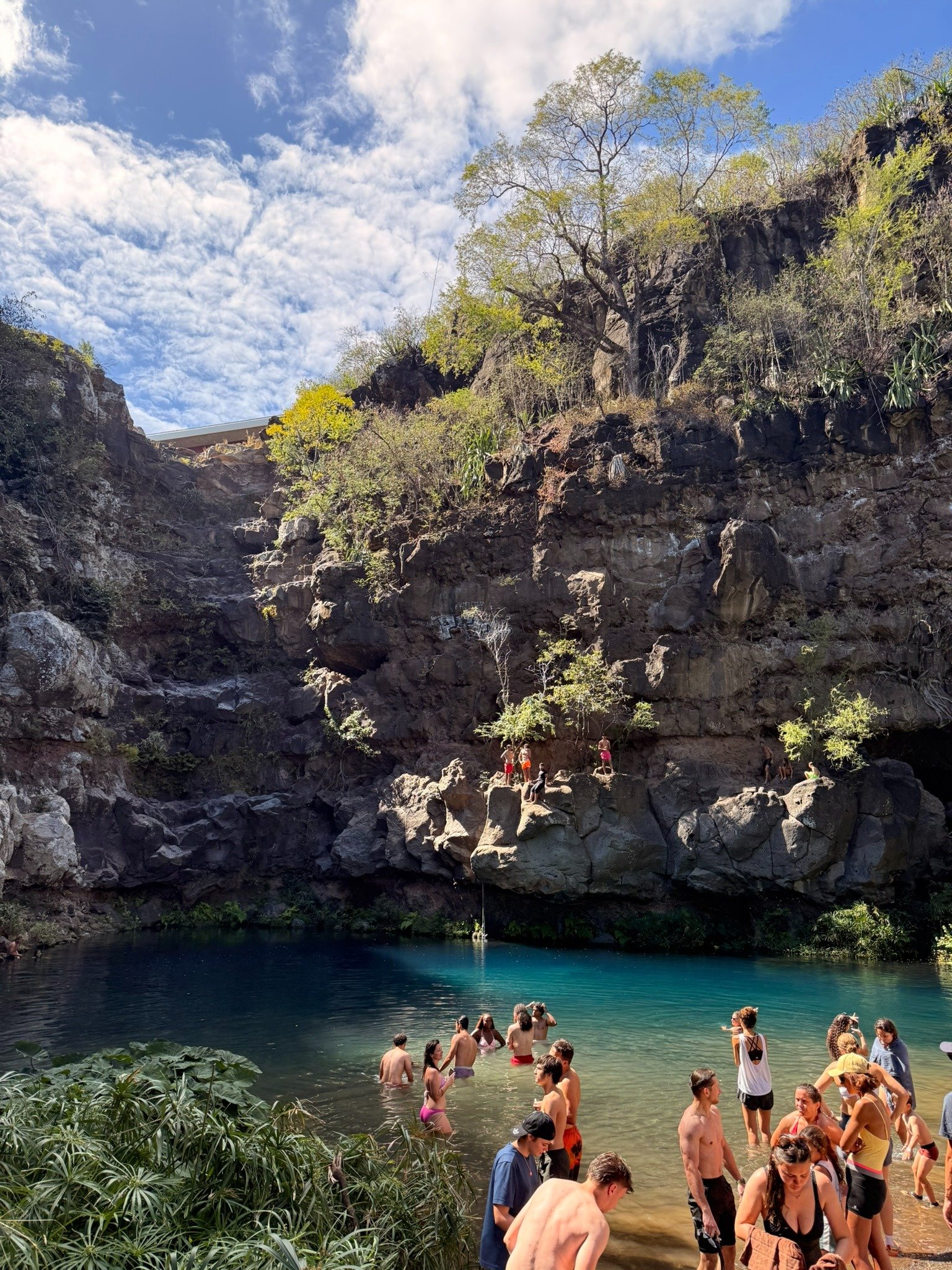
Green-turquoise water under a basalt wall, and nobody there. An hour and a half later, on the way back down, it looked like this.
Dozens of people. Families, groups of teenagers, a queue to get into the water.
And here’s the part nobody writes: access to the three basins is prohibited.
Étang-Salé: the beach where you build something
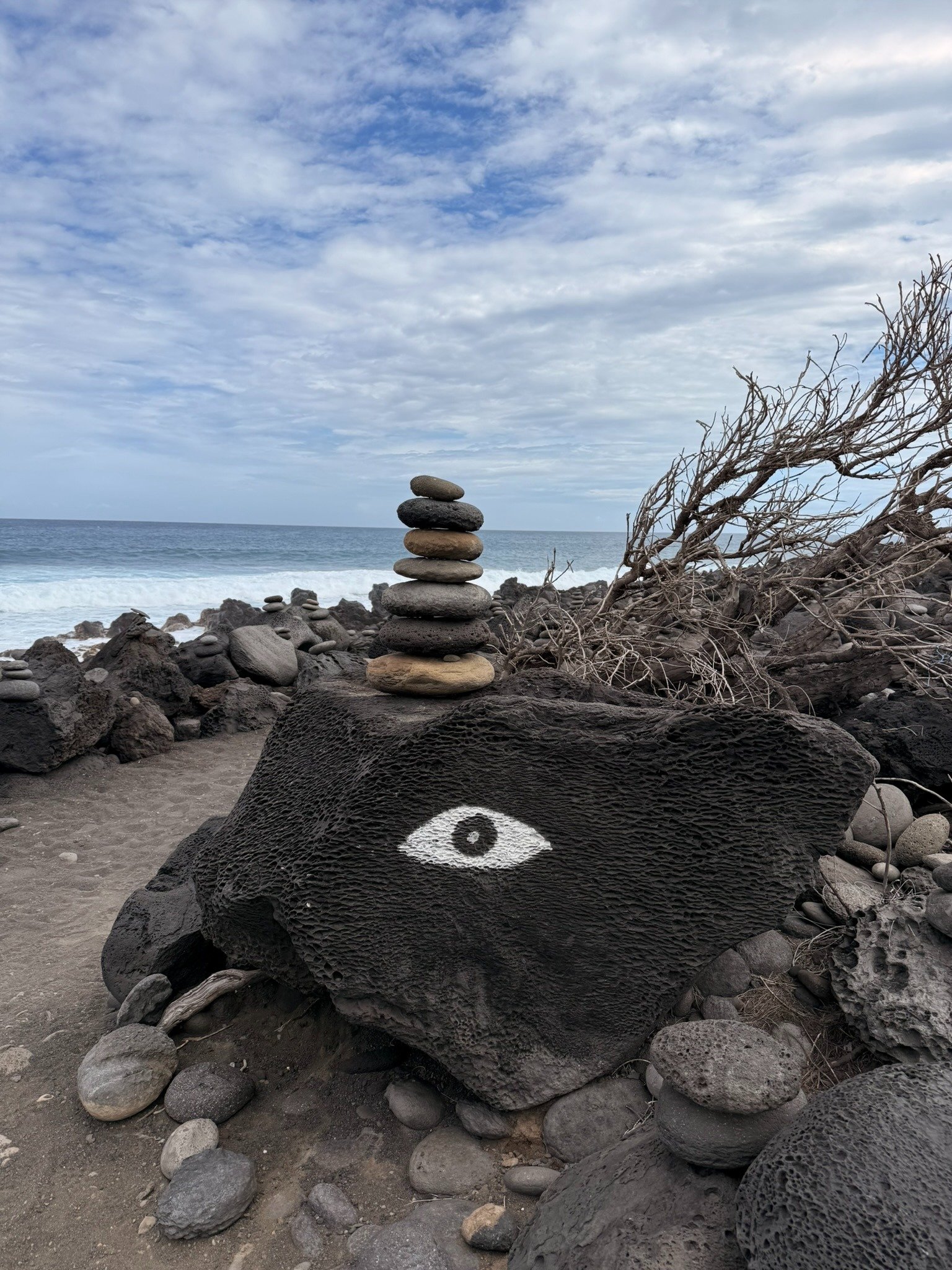
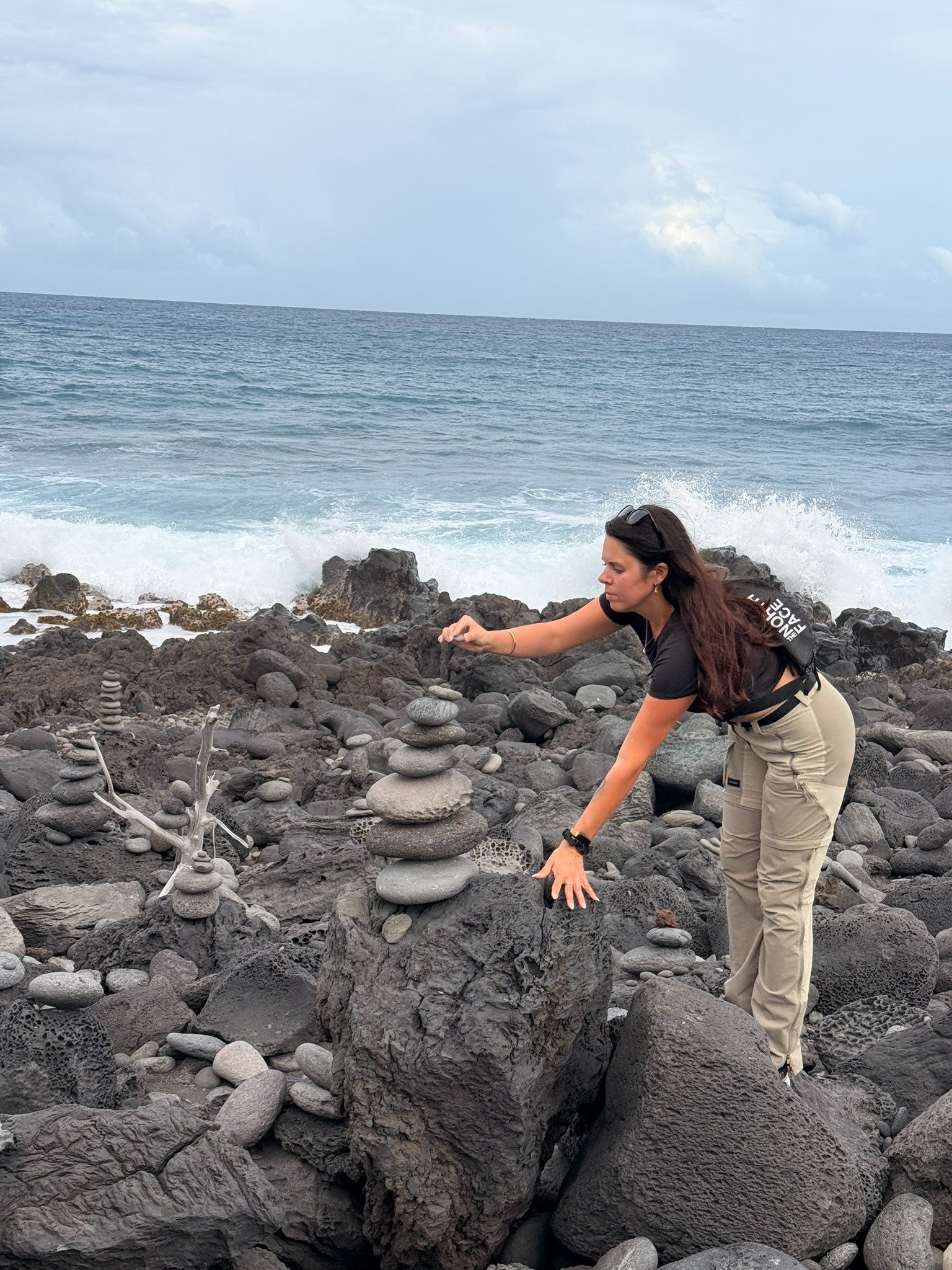
At Étang-Salé — supervised, black volcanic sand — there’s a stone path about a kilometre long that everyone calls the Vortex. Towers of stacked pebbles built by whoever walks past, words written on the rocks, a couple of Hindu statues, an eye painted on the basalt.
You walk it in single file, one behind the other, and each person sets their stone on top of the others: you’re laying the foundations of a new path. We built ours.
There’s no sign at the entrance, it isn’t an attraction, you won’t find it in the guidebooks. We only went because Tom knew it: he’d been there with his father.
The water you only look at
Worth saying, because it’s half the island: most of La Réunion’s best water isn’t water you get into.
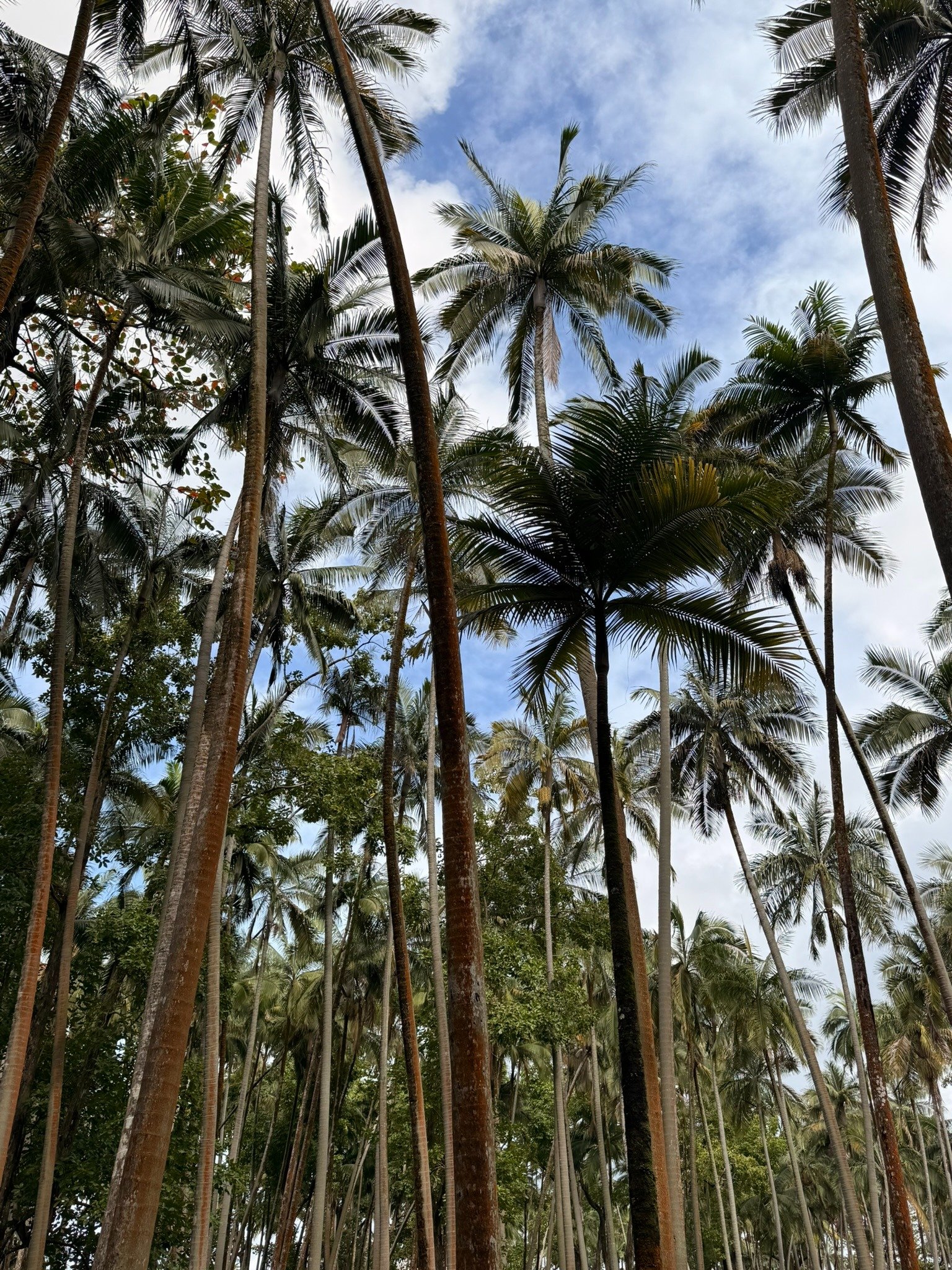
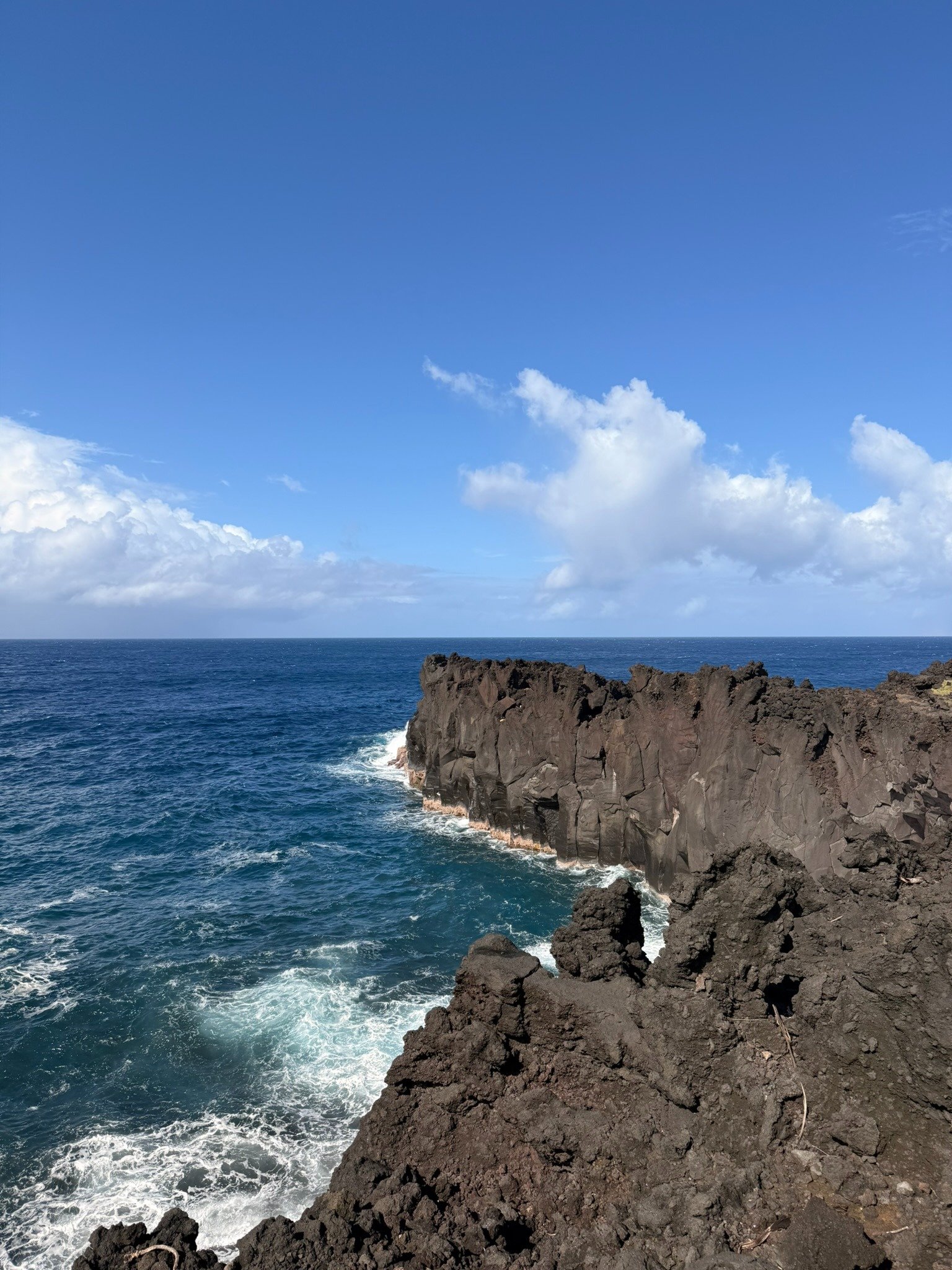
The waterfalls at Anse des Cascades drop into a palm grove twenty metres from the sea. Le Souffleur, at Saint-Leu, is a hole in the cliff where the swell rushes in and blows upward. The wild south coast at Cap Méchant is black basalt cut sheer into the ocean.
It isn’t a limitation — it’s how the island is built. You swim in the lagoon and you look at the rest, and it works perfectly well that way.
In practice
-
For a swim with nothing to think about: the lagoon. L’Hermitage or La Saline if it’s your first time.
-
Look for the white line offshore. That’s the reef, and that’s the boundary between inside and outside.
-
If you go to a supervised beach rather than a lagoon, check the zones and hours that same morning.
-
A mask and snorkel earn their place in your luggage — the lagoon is ten times better with them.
-
A crowd is not an authorisation — that goes double for the freshwater basins.
Frequently asked questions
Is it dangerous to swim in La Réunion? In the lagoon and in supervised zones, no — the whole island swims there every day, and the protections work. Outside those zones swimming is prohibited, and it’s a rule people respect.
Can you snorkel in La Réunion? Yes, and in the lagoon it’s one of the reasons to come: the reef is alive and the water is shallow. Since 2025, swimming with fins, mask and snorkel has also been permitted outside the lagoon, within the 300-metre band.
What about surfing? Surfing is the most restricted activity: surf, bodysurf, longboard and paddleboard are prohibited outside authorised zones. If you’re coming to La Réunion to surf, research it properly before you book.
Are the lagoons good for children? Yes — that’s their main use. Shallow, warm, and no waves.
Can you swim in the waterfalls and natural pools? It depends on the spot, and honestly many of the most famous ones are officially off-limits — the Trois Bassins above Saint-Gilles have been for twenty years.
When is the best time to go? June to September: slightly cooler water, more settled weather, and it’s the season when humpback whales pass offshore.
Was it worth it?
I arrived picturing a beach island and found a mountain island with a strip of warm sea in front of it. It took me a while to understand that this wasn’t a consolation prize: the lagoon is one of the most pleasant places I’ve ever got into the water, and you never get bored, because the rest of the island is half an hour away.
Tom never went through that adjustment. He watched the sea close when he was a boy, and reopen in pieces, behind nets and opening hours. To him the lagoon isn’t a compromise — it’s the sea.
Read next
-
La Réunion Beyond the Beaches: the Wild East and the Cirques
-
La Réunion: First Impressions of an Island That Doesn’t Let You Go