Saint-Tropez Without the Illusion: An Insider Guide From People Who Actually Worked Here
Most travel guides to Saint-Tropez are written by people who spent three days here in August, paid €22 for a rosé on the port, and called it research. This one isn't.
DESTINATION
5/8/20269 min read
We lived and worked a full season in Saint-Tropez — the kind of season where you're on your feet at 7am setting up terrace furniture before the first guests arrive, where you know which supermarket has the shortest queue on a Saturday, and where you learn very quickly that the Saint-Tropez the tourists see and the Saint-Tropez that actually exists are two completely different places.
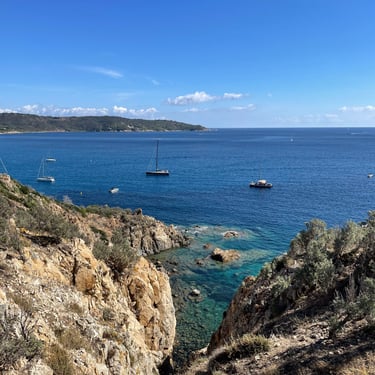
This guide is built from that experience. It's not about the glamour — though yes, the glamour exists and it's spectacular in its own ridiculous way. It's about the town underneath the superyachts. The fishermen. The bakery that opens at 5:30am. The beach you reach after two hours of trekking through maquis scrubland that rewards you with total silence and turquoise water and not a single beach club umbrella in sight.
If you want the influencer version of Saint-Tropez, there are ten thousand Instagram accounts for that. If you want the one that will actually make your trip better — keep reading.
The Port at 6am: Before the Performance Begins
There's a version of Saint-Tropez that almost no visitor ever sees, because it requires being awake and outside before the town decides to put its face on.
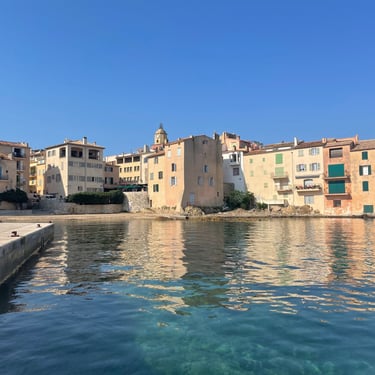
Before 7am, the port is still a working port. The fishing boats come in — small, unglamorous, salt-crusted — and the catch gets unloaded onto the dock with the same matter-of-fact efficiency it has for generations. The fishermen don't look like they're performing authenticity for your camera. They're just doing their job in a town that happens to also be one of the most photographed places in France.
The light at this hour is soft and golden and completely different from the harsh Côte d'Azur glare of midday. The pink and terracotta facades of the old town reflect it back beautifully. Bring your camera. You'll have the whole scene to yourself.
The boulangeries open early. The smell of bread coming out of the side streets near the old town is the best alarm clock you'll ever ignore. The locals who work in the service industry — the people who keep this town running during season — do their shopping and their coffee before the tourists arrive and make everything harder.
Where locals have breakfast (not on the port): Walk away from the water, up into the streets behind the Place des Lices. The further you get from the port view, the cheaper the coffee and the more likely the person next to you is a local. The port cafés charge you for the scenery. The cafés two streets back charge you for the coffee.
The Beaches Google Won't Tell You About
The famous beaches of Saint-Tropez — Pampelonne, Nikki Beach, Club 55 — are real, they're beautiful, and they will cost you an astonishing amount of money to access in any comfort. What the algorithm doesn't surface are the free alternatives.
Plage des Graniers
Fifteen minutes on foot from the center of town, south along the coastal path past the old cemetery. No beach clubs. No sunbed rental. No DJ. Just a small, sheltered bay with clear water, a mix of locals and families, and a simple snack bar if you need it.
In the height of summer it gets busy — but busy by Graniers standards still means you can find a spot on the sand without paying for the privilege. It's one of the few genuinely public beaches within walking distance of the old town, and for that reason it's quietly beloved by everyone who actually lives here.
Plage de la Bouillabaisse
On the other side of town, north along the bay toward Sainte-Maxime. This is where you'll see people who actually live in the area spending their afternoons — not the high season tourists, but the residents of the surrounding villages who know where to go. It's calm, it's not particularly dramatic, and it's almost entirely absent from the Saint-Tropez content ecosystem. Which is exactly why it's worth knowing about.
Cap Taillat — Our Favourite Place
This one requires effort. That's the entire point.
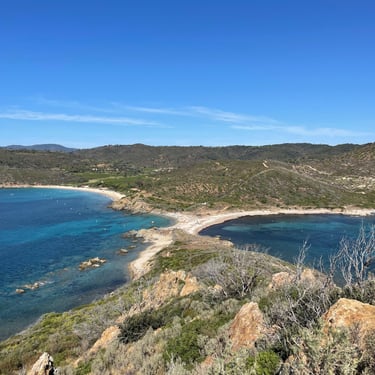
Cap Taillat is a wild, undeveloped headland south of Ramatuelle, accessible only on foot. The trail starts from the Bonne Terrasse parking area (GPS: near Ramatuelle, take the D93 toward Camarat, follow signs for Cap Taillat / Bonne Terrasse). The walk is approximately 4km each way — so 8km round trip — along a coastal path through Mediterranean scrubland, pine trees, and limestone cliffs. Expect about 2 hours each way at a relaxed pace.
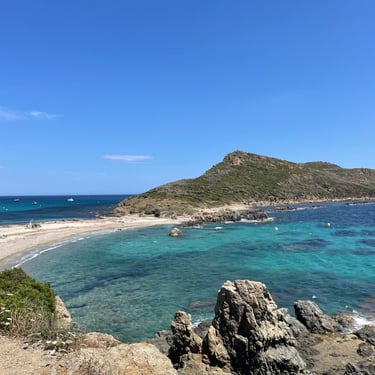
What you find at the end is a completely undeveloped beach on a narrow spit of land with water on both sides. On a clear day — which is most days in this part of the world — the color of the water is the kind of blue that makes you question whether you're still in France. There are no facilities. No shade. No vendors. Bring everything you need: water, food, sun protection, shoes with grip for the rocky sections.
What to bring: Minimum 2 liters of water per person. Snacks (there is genuinely nothing at the end). Reef-safe sunscreen. Proper walking shoes — not sandals. A towel you don't mind getting sandy. In summer, start early: the path is exposed and hot by 10am.
What to expect: Wild swimming off flat rocks. Complete silence except for the wind and the sea. The occasional technical day-tripper who hiked in from the other direction. And a view that we photographed and turned into a print, because it felt like the kind of place that deserved to exist on paper too.
The Provençal Market: Tuesday and Saturday Mornings
The market on Place des Lices is the real heart of Saint-Tropez — not the port, not the beaches, but this square with its plane trees and its chaos of lavender bundles and olive crates and people arguing in Provençal French about the price of tomatoes.
It runs Tuesday and Saturday mornings, roughly 8am to 1pm. In July and August it's packed to the point of being slightly overwhelming, which is also its own kind of pleasure. In June or September it's genuinely perfect.
What to buy: Local lavender (the real stuff, from Haute-Provence, not the tourist bundles assembled elsewhere). Tapenade from the producers who let you taste before you buy. Socca if someone is selling it — a crispy chickpea flatbread from Nice that occasionally makes an appearance. Aged goat cheese from the farms further inland. Fresh tomatoes and peaches in season, which taste nothing like what you get in a supermarket.
How to get there without suffering: This is critical. Do not drive into Saint-Tropez in July or August between 9am and 7pm unless you have a specific reason that cannot be achieved any other way. The traffic on the single road into the peninsula is legendary and genuinely traumatic. For the market, arrive before 8:30am (the parking near Place des Lices is manageable at this hour) or take the navette boat from Sainte-Maxime — see the transport section below.
The Villages Around Saint-Tropez That Nobody Visits
The peninsula and its immediate surroundings contain some of the most beautiful hill villages in Provence. Most tourists never see them because they're not on the main road and they don't have a port.
Gassin
Ten minutes by car from Saint-Tropez, straight up into the hills. Gassin is a medieval village perched on a ridge with views in every direction — the bay, the Maures massif, the coast toward Italy on a clear day. The village itself is tiny, classified as one of the "most beautiful villages of France," and almost entirely tourist-free even in high season. Walk the ramparts, have a coffee in the small square, look at the view. That's it. That's the whole thing. It's enough.
Ramatuelle
The village above the Pampelonne beach area, surrounded by vineyards producing the pale rosé that this region does better than almost anywhere. There's a Thursday market that's smaller and calmer than the one in Saint-Tropez. The cemetery here is where Gérard Philipe is buried, if that means something to you. The drive through the vines at golden hour is the kind of thing you don't expect to become a memory.
Grimaud
A medieval castle in ruins above a restored medieval village — it sounds like a cliché of Provence and it is, but it's a good one. The village around the castle has been carefully preserved and is completely walkable. Very few tourists make it here.
Cogolin
The anti-glamour capital of the peninsula. Cogolin is a working town — it has a carpet factory, a pipe manufacturer that's been making briar pipes since 1802 (genuinely worth visiting if you have any interest in craft), and a normal main street with normal shops and normal prices. It's where many of the people who work the Saint-Tropez season actually live, because they can afford to. It's also where some of the better restaurants on the peninsula are hiding.
Where to Eat Without Paying Saint-Tropez Prices
The fundamental rule: every 500 meters you walk away from the old port, the quality-to-price ratio improves significantly. The restaurants directly on the port are paying extraordinary rents and charging you accordingly. The food is often not better — sometimes it's worse.
The €4 breakfast rule: Coffee and a croissant in Saint-Tropez should cost €4-5 if you're drinking it at the bar or at a table away from the port view. If someone is charging you €12-18 for this, you're paying for your seat, not your breakfast. The cafés just behind the Place des Lices, and those on the road toward the market, are your friends.
In and around Saint-Tropez:
Cyril Lignac — The Parisian pastry chef has an outpost here. Worth it for breakfast or afternoon pastries; the quality is genuinely excellent and not absurdly priced given the context.
Gustavier — Another solid breakfast and brunch option favored by people who work in the industry here. Good coffee, reliable food, not tourist-trap pricing.
Papy Burger — For when you've spent all day on a beach and you want something unpretentious and fast in the evening. It exists, it's fine, it won't ruin your trip or your wallet.
In the surrounding area (where you should actually be eating):
Marina di Cogolin — Le Jardin Impérial: Vietnamese food that would be considered excellent anywhere in France. The marina itself is a pleasant, calm alternative to Saint-Tropez and the restaurant is the reason to make the trip.
Marina di Cogolin — The Note: Good bar and food in the same marina, different vibe. Worth knowing if you're spending an evening there.
Cogolin — Oliva Nera: Their pizza is the closest thing to a real Italian pizzeria you'll find on the peninsula. If you've been in France long enough to miss proper pizza, this is where you go. The crust, the balance of the toppings, the char — it's done correctly, which in this part of France is not to be taken for granted.
Sainte-Maxime — Capello: One of the better restaurants in Sainte-Maxime, which is itself a more affordable and underrated alternative base for exploring the whole area.
Port Grimaud — Brunchini: Port Grimaud is a strange and beautiful artificial "Venice of Provence" that deserves a half-day visit regardless, and Brunchini is a good reason to eat while you're there.
Saint-Tropez airport — Yaka Sushi: This sounds like a joke but it isn't. The small airport has a sushi counter that's considered the best option in the immediate area by the people who work nearby. If you're arriving or departing and hungry, it's genuinely good.
Getting There and Getting Around
This section could save you three hours of your life.
The traffic situation: The Saint-Tropez peninsula is accessed by a single road — the N98 and D98 — and in July and August it becomes one of the most congested roads in France. This is not an exaggeration. People have missed flights. There are documented cases of traffic jams extending to 25km. The only times it's manageable are before 9am and after 7pm.
Park & ride: There are several parking areas outside Saint-Tropez with shuttle buses into the center — at Cogolin and Port Grimaud in particular. Use them. Don't try to park in town.
The navette boat from Sainte-Maxime: This is the best-kept secret for avoiding the traffic entirely. Sainte-Maxime is on the opposite side of the bay, accessible on the autoroute without the peninsula bottleneck. A regular boat service crosses the bay directly to the Saint-Tropez port — it takes about 15 minutes, runs frequently in season, and costs a few euros. If you're staying in Sainte-Maxime or arriving from that direction, this is the only sensible option.
Bicycles: Possible, pleasant even, but only outside the main season. In July and August the traffic and heat make cycling on the roads genuinely dangerous. In May, June, September, October — excellent idea. The peninsula has some beautiful cycling routes through the vineyards and toward the beaches.
Where to Sleep
The honest version: in July and August, accommodation within Saint-Tropez itself costs an amount that will make you briefly reconsider your life choices. We're talking €300-500+ per night for a decent room in central town, and considerably more for anything with a view.
The sensible alternatives:
Sainte-Maxime is the most practical. It's directly across the bay, connected by the navette boat, and accommodation is roughly half the price for equivalent quality. It has its own pleasant beach, good restaurants, and the infrastructure of a real town rather than a seasonal spectacle.
La Croix-Valmer sits at the base of the peninsula toward Cap Lardier and is genuinely beautiful — more peaceful, surrounded by vineyards, and positioned perfectly for accessing both the wild beaches of the south coast (including the Cap Taillat trail) and Saint-Tropez by road.
Port Grimaud and Grimaud give you medieval authenticity and reasonable prices. Port Grimaud in particular is worth staying in rather than just visiting — the canals and the boat traffic and the evening light on the water are something.
→ Search accommodation options on Booking.com — filtering for Sainte-Maxime or La Croix-Valmer instead of Saint-Tropez itself will get you significantly more for your money.
Before You Go
The Cap Taillat print — our photograph from the end of that two-hour trek, printed in five sizes, available as an instant digital download. If you make the hike and want to remember what that water looks like in your house afterward, it's waiting for you.
→ Cap Taillat print on Etsy — Eli & Tom Studio
And if you want to understand what it actually means to work a season in a place like this — the 6am shifts, the back-of-house reality, the strange privilege of watching somewhere from the inside out — we wrote about that too.
→ Our story: what it means to work the season →
Eli & Tom are a nomadic couple who met working the hospitality season in Saint-Tropez. They document real places — the way they actually experienced them — on Instagram @eli.tom83 and sell travel photography prints at Eli & Tom Studio on Etsy.