

Rodrigues Island Travel Guide: What 3 Weeks Taught Us
Three weeks on Rodrigues Island, staying with Tom's family instead of a resort — the honest guide to what to do, what it costs, and what surprised us.
RODRIGUESDESTINATION
7/5/202611 min read
Rodrigues doesn't happen by accident. It's not on anyone's route, it doesn't show up on lists of the Indian Ocean's coolest destinations, and getting there means landing in Mauritius first and catching a second flight — a small plane, just over a hundred seats, the kind that reminds you you're actually going somewhere different.
We spent three weeks there. Not in a resort, not on a brochure itinerary — staying with Tom's family, who he hadn't seen in years and who still have their roots on the island. That changes almost everything that follows in this guide.
This isn't a list of the 10 best things to do, written from a desk. It's what we actually saw, ate, got wrong, and learned in three weeks.
Why Rodrigues Feels Like a Different Country Than Mauritius
Same nation, completely different experience. Rodrigues is smaller, has far less tourism infrastructure, and is more authentic because of it — no big hotel chains, no private beaches, around 40,000 people who mostly know each other. It's an island that hasn't decided to become a destination yet, and you can feel that everywhere, from the market in Port Mathurin to the empty beaches in the south.
How to Get to Rodrigues Island
The only way in is via Mauritius: an Air Mauritius flight of about an hour and a half, on a plane with just over a hundred seats. On board, a small snack (ours was a chicken sandwich, a KitKat, and a coffee) and two customs forms to fill out before landing — origin, accommodation, health status. It's not bureaucracy for its own sake; it's part of how Rodrigues protects its environment and its people's health.
A few minutes before landing, the water around the island becomes visible from above, and it's genuinely striking — the clarity is almost absurd, you can see the seabed from that altitude, with the coral reef marking the line between lagoon and open ocean. No photo does it justice.
Alternative: a ferry from Mauritius, about 36 hours — only for people with a lot of time and an even stronger stomach.
What it costs: our own trip started from La Réunion with a stopover in Mauritius, and came to about €400 round trip in total. If you're only booking the Mauritius–Rodrigues leg on its own, expect somewhere around €150–200 round trip.
The Arrival — Family, Not a Check-In
At Sir Gaëtan Duval Airport — small, one terminal, one runway, you're out in five minutes — Tom's family was waiting for us. He hadn't been back in years, and it showed: hugs, some not-quite-held-back tears, a scene you don't usually get at the check-in desk of a four-star boutique hotel.
A family lunch was waiting on the terrace: a table full of dishes, everyone talking over each other in Creole and French, genuine curiosity about our trip, a lot of laughing. I saw Tom laugh in a way I hadn't seen in months — the kind of lightness that only shows up when you're in the right place with the right people.
Where we stayed: with family, not in a guesthouse or resort. For travelers without that kind of local connection, the options are fewer but they exist — mostly family-run guesthouses, at prices well below what you'd pay in Mauritius.
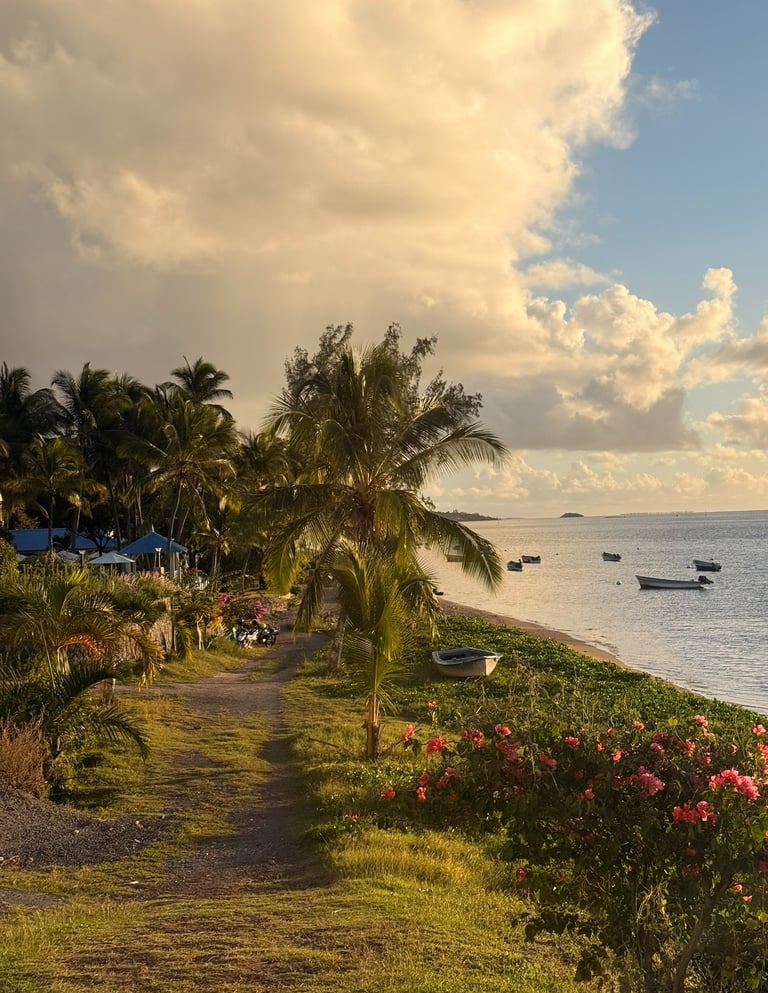
One we'd point people to: Coco Villa, a short distance from Port Mathurin, in a quiet spot right on the water. It has a pool, and the sunsets over the sea from that side of the island are hard to beat. Online listings put it somewhere around $48–55/night (roughly €45–50) — worth confirming current rates directly before booking, since aggregator sites don't always agree with each other.
Port Mathurin — The Market and Tom's Personal Map of the Island
Port Mathurin is the capital, if you can call it that: a few thousand people, narrow streets, colorful houses, a pace that feels stuck in the best version of the 1980s. We walked through the stalls at the bazaar — spices, local vegetables, fabric, everyday objects — nothing built for tourists, a real market used by people who actually live there.
The best part wasn't really what we saw, but how Tom saw it. Every corner had a story: the bar he went to as a kid, the street that led to a friend's house, the shop that was already there when he was small and is still there now. Walking Port Mathurin with him was nothing like any guided tour.
Worth seeking out in town: Zil Tropikal, a shop that makes its own t-shirts and small goods on the island instead of importing them and stamping "Rodrigues" on afterward.
A bit further out, near the center of the island, we tracked down the actual producers behind two other things we'd brought home: Bee Coco Cream (a citronella cream, good against mosquitoes and as skincare) and Miel Victoria, probably the best honey we tasted on the entire trip — along with honey candies that didn't survive the flight home. Buying directly from the people who make them, instead of from a shop shelf, was worth the detour.
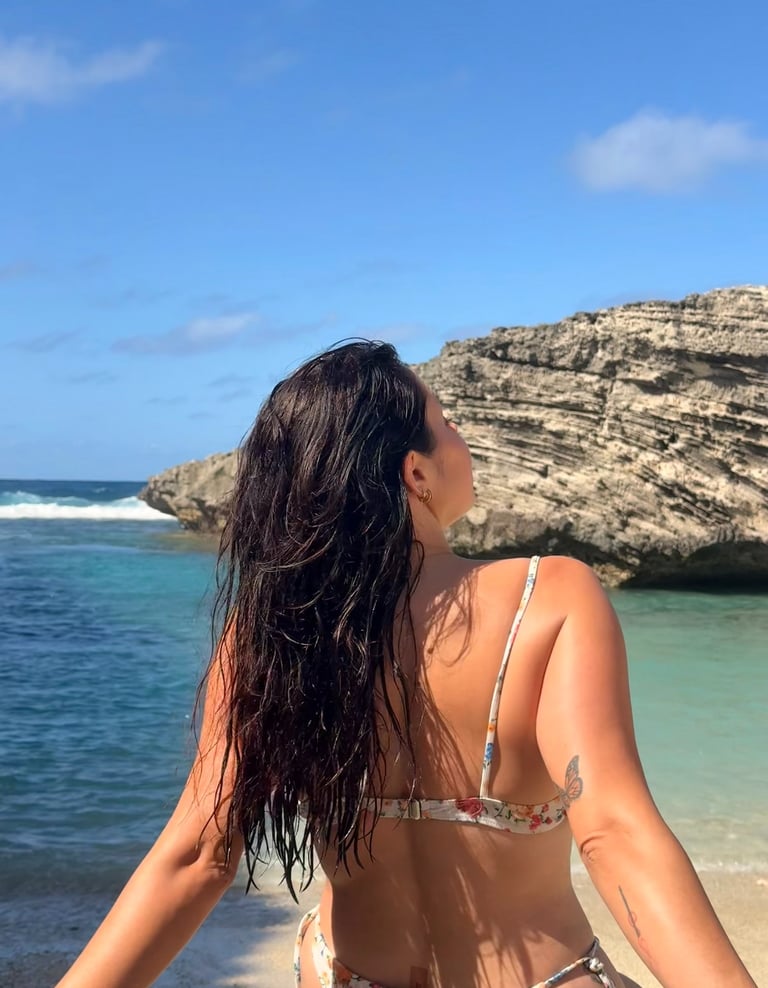
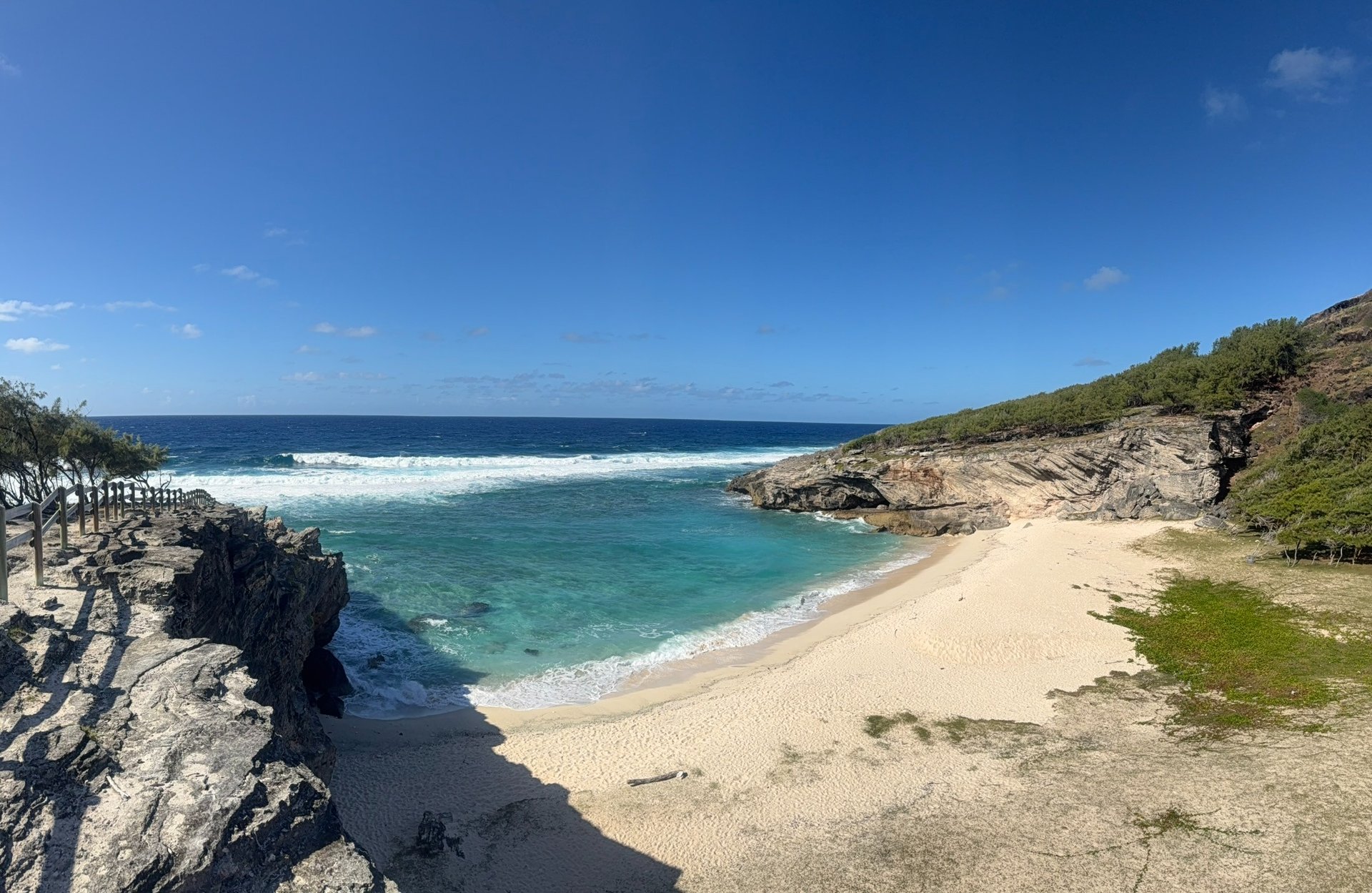
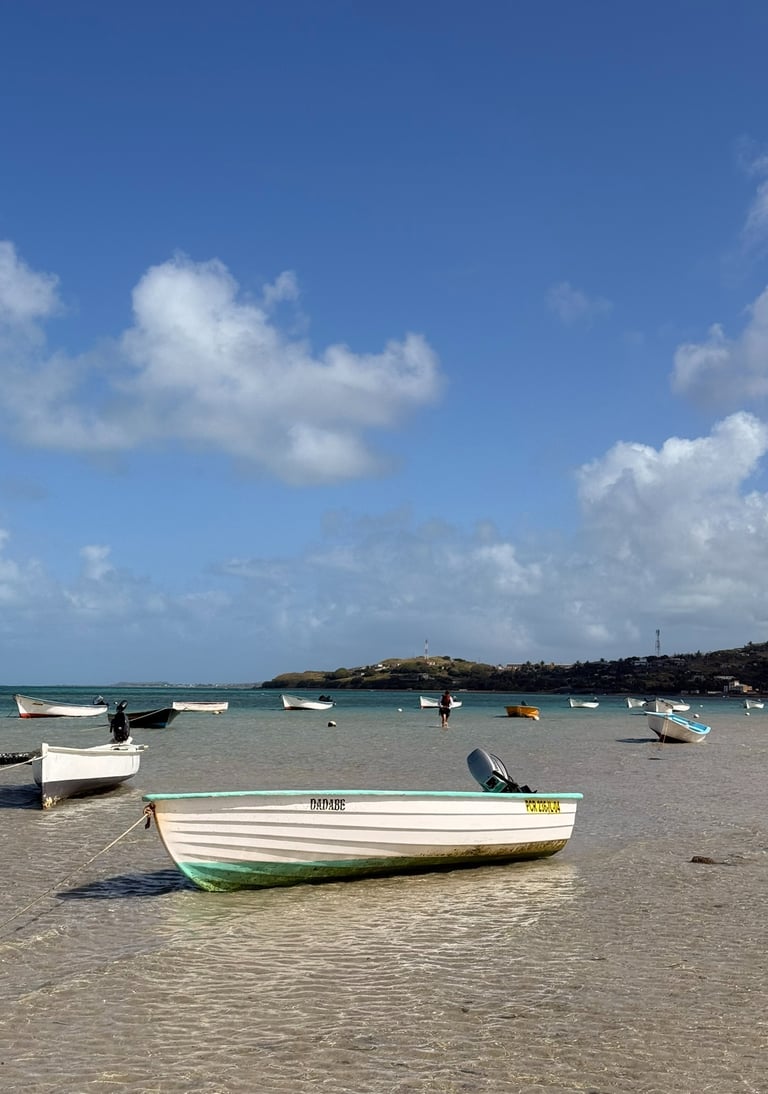
One of the best — and least predictable — days we had was on the coastal path that runs south from Saint François. After half an hour walking through low scrub and filao trees, the path opens onto Trou d'Argent: a small, almost perfect bay, closed in by two dark rock walls, pale sand, and water that shifts from seafoam green to cobalt blue within a few meters. Watch the current once you move away from shore — it's best to stay in the center of the bay.
A little further on, Anse Bouteille earned the title of best beach of the morning: wider, great for snorkeling at low tide, with a reef not far from shore.
Lunch in Saint François at Chez Solange et Robert, a restaurant with a handful of tables and a handwritten menu: grilled fish, Chinese and local sausages, grilled chicken, octopus and papaya salad, fresh local lime juice. Everything shared, everything good, served at the pace of a place where nobody's in a hurry.
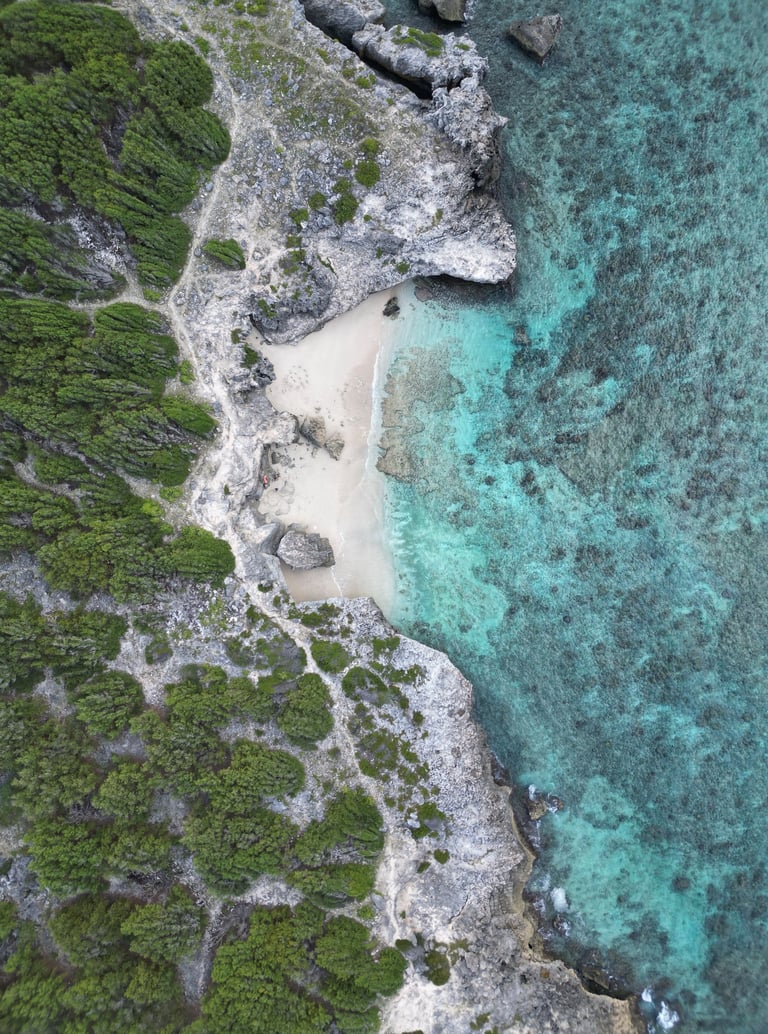
In the afternoon, we moved toward Cotton Bay for Trou Torrent, a small, barely signposted beach. Tom got the drone out for some aerial shots — and right as we were finishing, the sky went from clear blue to solid gray in a few minutes. A real tropical downpour, the kind that arrives and leaves faster than anything we've seen coming from Europe. We sheltered under a rock for about fifteen minutes, watching the sea turn dark gray under the rain. When it stopped, it stopped all at once — sun again, the smell of wet earth, Trou Torrent as quiet as if nothing had happened.
If you want to do this route: morning on foot (Saint François → Trou d'Argent → Anse Bouteille), lunch at Chez Solange et Robert, afternoon by car to Trou Torrent. Bring light hiking shoes, sunscreen, and a plan B for rain — the weather here changes in minutes, especially in the afternoon.
Kitesurfing at Mourouk and Deep-Sea Fishing with Tom's Uncle
Mourouk, on the northeast coast, is one of the best kitesurfing spots in the Indian Ocean thanks to steady trade winds — best season May to November, and we had good wind for several days in a row, not just one lucky afternoon. We wrote a full breakdown of the lagoon and conditions in our Mourouk kitesurfing guide.
An honest disclaimer: kitesurfing looks easy in videos. It isn't. Controlling the kite, balancing on the board, reading the wind — all at once, without ending up underwater every thirty seconds — takes a learning curve you can't rush in one afternoon. We still had a great time, especially since falling into the Rodrigues lagoon is, objectively, one of the least painful ways to fail at something. After the session, mines frites — stir-fried noodles with vegetables, egg, and a protein of your choice — one of the most common and satisfying dishes across the Indian Ocean islands.
On another morning, Tom left for two days of deep-sea fishing with his uncle, who runs the Rod Fishing Club, the family business that runs offshore fishing trips around Rodrigues — and holds thirteen world fishing records (marlin, tuna, swordfish). The waters around the island are among the best in the world for deep-sea fishing, and almost nobody knows it. Tom left as excited as a kid; I stayed on land with his cousins, exploring the island.
The Boat Day — Île aux Chats and Île l'Hermitage
Some days you don't really plan. You leave in the morning without particular expectations, with a wind already strong enough to move anything that isn't tied down, and you come back in the evening with that happy exhaustion that's hard to explain but easy to recognize. Our boat day in Rodrigues was exactly that — we've written up the full Île aux Chats boat day separately.
First rule we learned on the island: the wind decides everything. It's not an occasional nuisance like elsewhere — here it's a constant presence, part of the landscape. The morning of the boat trip, the sky was clear but the air was moving hard, as usual around here: potentially strong current, snorkeling in the marine reserve dependent on the weather, no guarantees. We brought the masks anyway.
The boat was small — the kind that makes you actually feel the sea, not the tourist-catamaran version. Our guide for the day, Jeff, gave us moments we won't forget. Île aux Chats is a tiny islet, and the name doesn't lie: dozens of cats scattered across the rocks in the shade, watching with the same quiet superiority as some of the island's older residents. It's not a built attraction — it's simply a place where the cats settled in and visitors are welcome guests. A path runs the whole perimeter of the island, through wild cotton plants, bright white sand, and charcoal-colored rock.
Lunch: a fresh fish barbecue, eaten with our hands, sitting outside, the sound of the sea close by and the smell of smoke mixing with the salt air. Tom talked with the fishermen in Creole — I understood little, but the tone was that of people who share something without needing to explain it.
Snorkeling in the reserve that day was borderline — strong current, wind not helping — but the seabed, when we managed to see it, was extraordinary: colorful fish, coral still intact. Afterward, the boat took us to Île l'Hermitage: smaller, bare, nothing built for tourism. Ten minutes uphill gets you a 360-degree view over the whole reserve, with Mourouk and its kitesurf sails visible in the distance.
What to bring: waterproof sunscreen, a change of clothes, a windbreaker (the wind shifts fast even in the sun), sea legs for rough water, and flexible expectations about snorkeling — conditions vary, and that's part of the experience.
What Surprised Us
The slowness is the first thing you feel, and it happens almost immediately. There's no real traffic on Rodrigues — nobody rushes in a car or on a scooter, everything moves at half-speed compared to what we were used to. The island is small enough to get around comfortably on a 125cc scooter, which is exactly what we did, and driving is on the left, like in the UK. After a day or two, that slowness stops feeling like an absence of something and starts feeling like the point.
It's also an island that, in places, feels caught out of time. Fruit and vegetables are bought at the market, not a supermarket. In some of the less touristy areas, kids would look at us with open, unfiltered curiosity — seeing someone white is genuinely rare for them, and they'd study us like we were the interesting part of their day, which, fair enough, we probably were. Some adults on the island never learned to read or do basic arithmetic; kids who do go to school, on the other hand, come out properly bilingual, taught both French and English and speaking both correctly. That gap says a lot about how recently the island has had real access to consistent schooling.
Healthcare is another place where the slowness stops being charming and becomes a real practical limit: there's one hospital on the entire island, and it isn't equipped for most serious procedures. If something more serious than a routine issue comes up, people travel to Mauritius. It's the kind of detail that doesn't show up in a highlight reel, but it's part of what makes Rodrigues what it is — and worth knowing if you're planning to spend real time there, not just pass through.
What Three Weeks Actually Cost
Here's the honest part: staying with Tom's family meant we barely spent anything. Outside the flight, our costs for three weeks came down to a handful of souvenirs — no accommodation, no rent, most meals covered by people who wouldn't hear of us paying. That's not a number readers can plan around, so it's worth separating our actual spend from what it would realistically cost someone without that kind of local connection.
If you're staying at a guesthouse like Coco Villa and covering your own meals, a reasonable estimate is: guesthouse accommodation around €25–50/night, food €15–25/day, plus the flight above — roughly €400–600 per person for a one-week stay, scaling from there. That's an estimate based on typical Rodrigues guesthouse and food costs, not a number we paid ourselves, so treat it as a planning starting point rather than a guarantee.
Things to Do in Rodrigues, at a Glance
Everything above, in one place, if you're just here for the list:
Hike to Trou d'Argent and Anse Bouteille — the south coast walk from Saint François, two of the best beaches on the island.
Kitesurf at Mourouk — steady trade winds, one of the best-kept kitesurf spots in the Indian Ocean.
Take a boat day to Île aux Chats and Île l'Hermitage — snorkeling, a fresh fish barbecue, an islet full of cats.
Visit the Rodrigues tortoise reserve — over 12,000 giant land tortoises, some curious enough to walk right up to you.
Walk the bazaar in Port Mathurin — and if you can, buy honey and citronella cream straight from the producers near the island's center.
Rodrigues vs Mauritius — The Quick Comparison
Mauritius: developed tourism infrastructure, resorts, equipped beaches, more options but also more crowds and higher prices. Rodrigues: no international resorts, a slow pace, a community where everyone knows each other, a lower budget, a more authentic experience but less comfort and fewer backup options if something goes wrong (few flights, few guesthouses, slow wifi). If you want comfort and variety, choose Mauritius. If you want slowness, authenticity, and an island that hasn't fully opened up to mass tourism yet, choose Rodrigues — we'd make the same choice again.
Practical Information
How to get there - Only via Mauritius — Air Mauritius flight, about 1h30. Book well ahead, seats sell out.
Customs - Two forms to fill out in-flight (origin, accommodation, health). Mandatory.
Currency - Mauritian Rupee (MUR). Bring cash from Mauritius — few ATMs.
Language - French and Creole. English isn't widely spoken outside tourism.
Getting around - Rent a scooter or car from day one. Buses exist but are slow and limited.
WiFi - Slow and not always reliable. Download offline maps before arriving.
Kitesurfing - Mourouk, northeast coast — steady wind year-round thanks to the trade winds.
Best season - April–November (dry season). December–March is cyclone season.
Minimum stay - 5–7 days to actually settle into the island's pace.
Frequently Asked Questions
Is Rodrigues worth visiting? Yes, if you're after a slow, low-tourism island with empty beaches and a Creole culture that's still very much intact. Less suited to travelers looking for resort comfort or nightlife.
How many days do you need? At least 5–7 to not feel rushed. We stayed three weeks and it wasn't too long.
Rodrigues or Mauritius? Depends what you're after — see the comparison above. Many travelers combine both on the same trip, since Rodrigues can only be reached via Mauritius anyway.
How do you get to Rodrigues? Only by plane or ferry from Mauritius — there are no direct flights from Europe. See "How to Get to Rodrigues Island" above.
This article is part of our Indian Ocean coverage — you'll also find what we packed for 3 months between Réunion and Rodrigues, kitesurfing at Mourouk, our boat day at Île aux Chats, a morning with the island's giant tortoises, the local products we brought home, and our first four days on the island.
The full Rodrigues guide on Rexby and the Indian Ocean Guide are coming soon.
The South Coast: Trou d'Argent, Anse Bouteille, and a Downpour at Trou Torrent